Search

Jamie Davis Writes

Tag

book quotes about writing

Notes From a Reading Journal: The Rules of Magic, by Alice Hoffman

Notes from a Reading Journal: “The Rules of Magic,” by Alice Hoffman.

What a heartbreakingly enchanting novel! I am so glad that Book of the Month Club made this my November selection. Now I have marked “Practical Magic” on my to be read list!

I loved the 1960s Manhattan and Massachusetts setting, and the relationships between siblings Vincent; Jet; and Franny and their respective loves. The fact that there is witchery afoot was sort of a “fun” element for me. In my opinion, the real star of the show is the heartbreak and joy of the stories of the lives of the characters.

This is a story of how each life ends for a time, but begins again. Will the Owens siblings beat their family’s curse?  

Two big questions that I noted while reading that I was happy were resolved were:  What was Vincent’s premonition? How was it right / how was it wrong? What did Isabella whisper to Franny?

I had to note the roles that journaling played in the story as well! Maria Owens, the  ancestor, had a journal that was kept in the rare book room in the library. Later, Franny would leave journals out for the teenage girls to pick up and take home (“Clearly convinced that words could save them – p. 314.”) I loved that!

Quotes I Collected in my Reading Journal:

·      Page 161: “What’s done cannot be undone.”

·      Page 254: “Nature could be shifted, but not controlled.”

·      Page 257: “Things ended, and then they began again.”

·      Page 57: “Writing itself was a magical act in which imagination altered reality and gave form to power. To this end, the book was the most powerful element of all.”

·      Page 346: “The truth was, they had managed to get what they wanted. It just wasn’t lasting long enough, not that it ever could.”

·      Page 331: “In truth it is easier to let your old life disappear in order to start anew.”

Love more. Not less. — Jamie Whitmer

Notes From a Reading Journal: Little Fires Everywhere, by Celeste Ng 

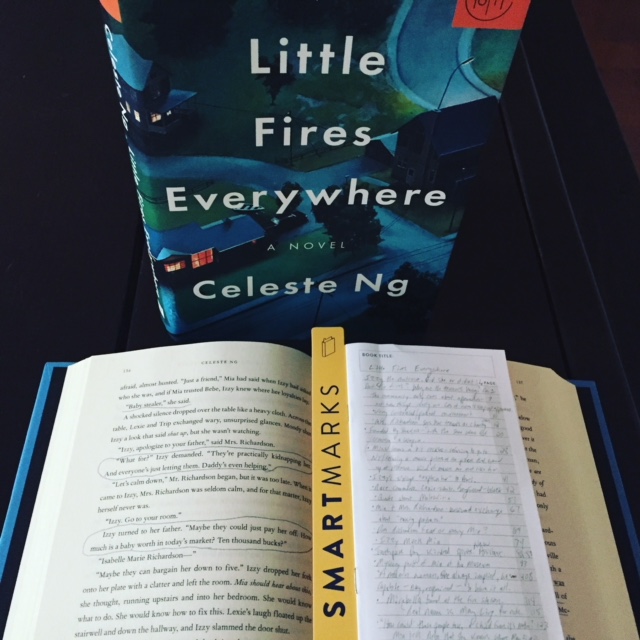
Notes from Smartmarks by BestSelf Co, while traveling without my reading journal. These bookmarks with notes were the perfect travel solution for me! At home, I keep a reading journal for my notes, but I was able to tear my notes out when I got home and filed them within my reading journal. The Smartmarks were very convenient! 

This selection was an extra purchase I made through Book of the Month Club after hearing so much buzz about the book. I found “Little Fires Everywhere” to be an absorbing book, guaranteed to make you think and spark debate among book club members everywhere. 

At first, I thought the book was going to be focused more on Izzy and her alleged “craziness,” as her siblings refer to her issues, but it was more of a character study of Izzy’s entire family (the Richardsons) and their new tenants, artist mother Mia and her daughter, Pearl. By the way, Izzy is not “crazy,” she just doesn’t fit into the cookie-cutter mold her family wishes to mold her into.

While there were plenty of witty and even positive exchanges in the story, make no mistake about it, this is no fairy tale happy ending of a story. Ideas to spark discussion come from such themes as: teenage pregnancy; adoption; what lies beneath the “perfect” neighborhood; what makes someone a mother; and what is heartbreak. What are the things that we carry with us? 

What are the sacrifices we make in the pursuit of a better life? Were they worth it?

The story takes place in Shaker Heights, a planned community that has lots of rules, and is the embodiment of a neighborhood that is really only concerned with the surface being perfect, and damn what lies beneath! 

In my opinion, the most evil character is do-gooder suburban mother Mrs. Richardson. She ruins lives by her interference. She never does a good deed without calculating it for a return favor later, and if she does something she deems “good” for another person, she expects the recipient to kowtow to her. And oh, how judgmental she is. Mrs. Richardson actually may take the nomination for most-hated literary character this year. 

Mia, the artistic mother, is highly gifted, but will not “sell out” when it comes to her art. Thus, she provides a poverty-stricken, nomadic lifestyle for her daughter, Pearl. Yet, she somehow always manages to supplement her artist’s income with menial jobs, and while they are not rich in material goods, they don’t seem to go without the necessities. This is a huge debate for readers to discuss. What is the parental obligation to provide for a child? If you have the ability to generate a lot of income, what is your obligation to make money if you are able? To what extent does security and stability come in to play over adventure and art when raising a child on your own? We know that Mia had the talent and the connections in Manhattan to make a great deal of money as an artist, but she did not want to sell out. (Arguably, she may have been worried about becoming too high-profile because then she may have caught the attention of the Ryans, which if you have read the book, you know she had to stay hidden).   

Another big issue for debate is what readers think of Bebe giving up May Ling and then the custody battle between her and the adoptive parents, Linda and Mark McCullough. Do you think the judge’s ruling was fair? What do you think about Bebe’s actions in the end of the book? Are there circumstances so severe that people no longer deserve a second chance?

The way Ng interweaves the story of Mia and Bebe is masterful. I was engaged, and wanted to keep reading to find out Mia’s secrets. 

Other relationships and questions to discuss: the relationship between Mia and her parents; what you think of the relationship between Mia and the Ryans; does Lexie regret her big decision; and who does Pearl’s heart break for – the loss of the relationship with Trip or with Moody? What do you think happens to Izzy in the end? 

Quotes I Collected for my Reading Journal:

·      Page 245: “You’ll always be sad about this, Mia said softly. But it doesn’t mean you made the wrong choice. It’s just something that you have to carry.” 

·      Page 250: “The question is whether things are still the same. Whether she should get another chance… Most of the time, everyone deserves more than one chance. We all do things we regret now and then. You just have to carry them with you.” 

·      Page 295: “Sometimes, just when you think everything’s gone, you find a way… Like a prairie fire. I saw one, years ago, when we were in Nebraska. It seems like the end of the world. The earth is all scorched and black, and everything green is gone. But after the burning the soil is richer, and new things can grow… People are like that, too, you know. They start over. They find a way.”

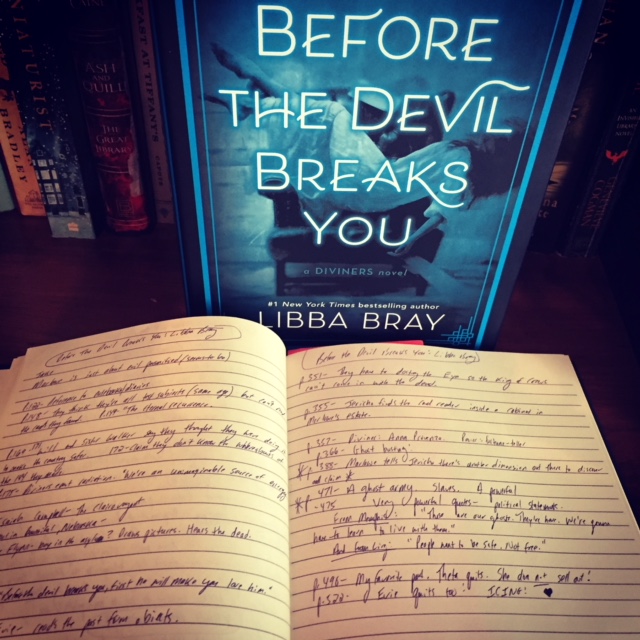
Notes From a Reading Journal: Before the Devil Breaks You, by Libba Bray 

Notes from a Reading Journal

Before the Devil Breaks You” is Book 3 in the 4-part Diviners series by Libba Bray.

There is a lot going on in Book 3! I adore this 1920s paranormal series! Libba Bray acknowledges that at the time she was writing this book, there was a lot going on in America politically, and I think she strikes the perfect balance of writing for entertainment without preaching politically. That’s a hard thing to do, by the way. Having just finished Stephen and Owen King’s “Sleeping Beauties,” even recognized masters get this wrong. There is entertainment, and then there are political pieces masked as entertainment. Ahem. But I digress…  

First, the “fun” elements in the plot of “Before the Devil Breaks You.” The Diviners visit an asylum to hunt ghosts, and there is ghostly activity around Manhattan that might remind the reader of the movie “Ghost-Busters”. I also enjoyed learning the lingo from that time period. The characters say such phrases as: 

         “You jake?”

         “Strictly top-drawer”

         “Baby Vamp”

         “And how!”

         “On the level”

         “Let’s ankle”  

Now on the darker fare. The King of Crows is back with an army of the dead. I’m still trying to figure out what the “Eye” is, but it sounds to be some sort of portal between Earth and another dimension (seemingly the land of the dead or wherever The King of Crows comes from. Hell? Because without question, The King of Crows is a demon). I think the “Eye” is going to be the focus of the last book as far as the Diviners are supposed to find it and destroy it, thus finally closing the entry door of Earth to The King of Crows. I got the impression that it has to do with Marlowe and his quest to discover and conquer another dimension. Marlowe is just about evil personified on Earth!

In the book, we delve deeper into Project Buffalo’s roots inside the Department of Paranormal, a former government agency. This agency’s purpose was to engineer Diviners in the womb, in an attempt to breed a race of super-powered Americans. Just as in the real 1920s Eugenics Record Office at Cold Spring Harbor Laboratory on Long Island, which Bray writes in her author’s note, “supported by Harrimans, Carnegies, and Rockefellers.” This story line is absolutely terrifying and evil, and even more so because it is based on reality!

We find out that Evie; Theta; Henry; Sam; Ling; Memphis; and Isaiah were all manufactured to have super powers that were derived by administering Marlowe’s serum to their mothers. The specific power that would develop as a result of administering the serum seems to be something that the agency could not control. 

The portrayal of the Manhattan State Hospital for the Insane was inspired by a fictional amalgam of real New York Kirkbride asylums and their cemeteries, such as Ward’s Island; Roosevelt Island; and Hart’s Island. I liked the mention of Nellie Bly’s 1887 “Ten Days in a Mad-House” to demonstrate how investigative journalism led to sweeping reform in the state’s asylums, and led to much better care of the mental ill by the 1920s. However, there were still terrifying things going on, and one of the scariest things was sterilization under the Supreme Court’s 1927 ruling in Buck v. Bell. 

Quotes I Collected in my Reading Journal:

·      Page 12: “When you talk about seeing ghosts, most people assume you’re either crazy or drunk or both.”

·      About writing, from Ling’s perspective. Page 51: “Ling cracked open the notebook, inhaling the scent of good leather and of the possibilities lurking in all those blank pages.”   

·      P. 185: “Before the Devil breaks you, first he will make you love him.”

·      By Memphis, P. 475: “These are our ghosts. They’re here. We’re gonna have to learn to live with them.” And from Ling, “People want to be safe. Not free.”

Other revelations? Two main characters are murdered. We finally find out who Blind Bill Johnson is, and that’s a great story line (There once was a Diviner who could pull life from things…)! Evie and Theta both quit their show-business jobs rather than be forced to be controlled by their bosses, which were very inspiring actions. Shame about Jericho and Evie, though. I’ll leave it at that. I wish that part of the story didn’t have to happen.  — Jamie Whitmer

Morning Pages or Meditation? 

It turns out I have been writing morning pages longer than I have been aware that they had a name for that! Julia Cameron’s Morning Pages were made news to me last December when I picked up Tim Ferriss’s “Tools of Titans.” Before then, I just referred to my writing practice as journaling, and the practice would occur sporadically throughout the day; according to my mood; or in the evening while I tried to play catch up from the day’s events. To be fair, although I have always kept a journal, I never followed a strict, first things first policy until I heard about Cameron’s morning pages practice and decided to give her way a try.    

I still keep notes or journal throughout the day as the mood strikes me, but I do the morning pages work first as an active meditation, and to start my day off on the pattern and practice of taking care of myself first before engaging in work for others. This is me securing my own safety mask before I render help to others!

I have not done a ton of research yet into morning pages, but I am not surprised by the volume of testaments to the practice that I have read so far. Some people have gone as far as saying it is a religious experience for them – that they have found God speaking to them through their writing.

I can see that. The inner guidance and insight that comes from the morning pages practice certainly feels like it could be God, or the universe, trying to get through to me. I think that’s the big answer. Only through the quiet turning of looking inward can we get in tune and start to hear. What will a searching soul find? Will you be strong enough and wise enough to recognize what you need to change after your problems and issues are staring you in the face? Because  after two weeks of the morning pages practice I was forced to to take some accountability and action for my own life’s choices and happiness because there was no getting around the fact that I had been writing about the same whine and agonizing over the same issue. It was a powerful moment. A life changing moment (and one for the better).

I don’t do traditional passive meditation. I can sit on the back porch on a chair and listen to the wind for a few minutes, and I guess that counts, but I haven’t incorporated it into my daily habits yet. Right now, writing my morning pages is where I put my time investment and from doing that I am able to start my day completely at peace and feeling strong. I feel that for my personality type, active meditations give me the best benefit, and writing by far is the most obvious fit. There are also plenty of active meditation moments throughout the day when I try to breathe and quiet my mind, such as exercising; preparing a meal; or when grooming.    

Julia Cameron on Morning Pages in “The Miracle of Morning Pages”:

“Morning Pages are about action. Unlike conventional meditation, which may lull you out of taking action, the pages magnify our discontent, pointing out actions we could take. The pages tend to point out our many choice points. We are egged on to increase honesty and candor. Our lives become our own. We no longer sell ourselves out, giving our time and energy to others’ agenda. We have a choice whether to invest in others or ourselves. Investing in ourselves is novel for many of us.”

Because writing is an active exercise, I am more likely to become aware of changes to make or actions to take to move forward when I do the morning pages work. I agree with Cameron’s assessment of traditional meditation alone, in that I have found it to be true that it lulls me into what I feel is a dangerous spiritual complacency in the sense that yes, I am feeling good or peaceful, but in reality what that means is I’ve just taken the lazy man’s way out and adapted a coping mechanism to a problem so that I have made myself be “okay” with problems instead of making any real changes. I hate it when people don’t deal with problems, and I hate it when I’m guilty of avoidance too. I really strive to be accountable when I realize that action must be taken.

When I was transitioning out of the law firm, I used to say: “I don’t need a glass of wine. I need to change my life.” For me, coping mechanisms are dangerous because they let me get myself stuck in less than prime situations. Coping mechanisms are only to be used in the event of tragedy or other dire circumstances; or if I am just absolutely burning out, and that is how I view passive meditation. If meditation works for you, that’s great. I’m just telling you that meditation alone isn’t for me. I’ve tried it, and I get better benefits from active meditation through writing the morning pages daily.

That being said, now that I have successfully developed the sticky habit of doing the morning pages daily, I will try to combine that habit by stacking on five minutes after work in the late afternoon or early evening and see if I can make traditional meditation stick.

It will be interesting to see if I notice any changes after thirty days of stacking these habits! I have made a new habit tracker to begin tomorrow. The game is afoot. 

Authors Who Kept Notebooks

Such gems from W. Somerset Maugham’s A Writer’s Notebook! Notes from a genius. Written 121 years ago. Timeless (and in some cases, terrifying!).

  • 1896: “From the standpoint of pure reason, there are no good grounds to support the claim that one should sacrifice one’s own happiness to that of others.”
  • 1896: …”but the banker always wins.”
  • 1896: “Can the perfect adaptation of man to society ever take place? It may be that the sheer struggle for existence will be put an end to, but will that effect the end desired?”
  • 1896: “There are few minds in a century that can look upon a new idea without terror.”
  • 1896: “A moral code is accepted by the weak-minded; the strong form their own.”
  • 1896: “Everything in life is meaningless, the pain and the suffering are fruitless and futile. There is no object in life.”

I am always fascinated by notebooks and journals kept by authors. Oftentimes, they can be a pure glance into the state of the writer’s mind. There are parts equally dark and light, but artists are usually forthcoming about the extent of the darkness. There are no attempts made to sugarcoat things.

Book Quotes About Writing – “The Hawley Book of the Dead”

Loving this quote about writing from P.51 of “The Hawley Book of the Dead,” by Chrysler Szarlan.

Writing is a kind of magic. One person sits in a room alone and makes marks on a page that represent the images in her mind. Another person looks at those marks, weeks or months or a hundred years later, and similar images appear in that person’s mind. Magic.”

Fill your pages! Travel. Write. Index. Repeat. Make magic. That’s all.  

Create a free website or blog at WordPress.com.

Up ↑