Throwback to traveling days for Haunted Asylums, Prisons, and Sanatoriums. A sampling of some of my favorite exterior photos to get into the Halloween spirit!
Mansfield (Ohio State Reformatory)
Mansfield – The Ohio State ReformatoryMansfield – The Ohio State ReformatoryMansfield – The Ohio State Reformatory
Why is my favorite color “Institution Green” as seen above? Maybe I’ll just refer to it as “Seafoam,” or “Mint Green” when mixing among polite society.
West Virginia State Pen
West Virginia State PenWest Virginia State PenWest Virginia State Pen
A horror classic, but you will have to work for it! I probably spent five days trying to get through this book. Is it rewarding? Yes. But you will have to work for it! My best guess is that I became stalled because the writing is very poetic, and my brain didn’t logically follow the prose as quickly as I normally would. One example on Page 257: “Every glass threw javelins of light which invisibly pierced, sank deep, found heart, soul, lungs, to frost the veins, cut nerves, send Will to ruin, paralyze and then kick-football heart. Hamstrung, the old old man foundered to his knees, as did his suppliant images, his congregation of terrified selves one week, one month, two years, twenty, fifty, seventy, ninety years from now!”
Multiply that paragraph to fill up a 290 page book, and you can see why I did not exactly fly through this book. It was work for me, not an easy pleasure read.
There are plenty of terrifying scenes involving the carnival and its characters, and the book is absolutely a prime example of how “to get it right” if you are an author studying such things. I’m just saying read this when you have a caffeine buzz, and not when you are tired from having already worked all day!
I did enjoy the feel-good aspect of the father (a janitor in the town’s library) getting to play the hero to his son and his son’s friend, although some might say the Aw Shucks aspect of the early 1960’s does not translate so well to today’s times (which is a shame).
Throwback to traveling days for Haunted Asylums, Prisons, and Sanatoriums. A sampling of some of my favorite exterior photos to get into the Halloween spirit!
Yorktown Memorial Hospital – Yorktown, TX
Yorktown Memorial HospitalYorktown Memorial Hospital
I was introduced to the series because of a random walk-in at our local Book Warehouse outlet. The mystery series, starring twelve-year old English heroine Flavia de Luce strikes the right balance between precocious and obnoxious, which is a hard thing to do when writing a child’s character! I particularly enjoyed this seventh book because we got to see Flavia in an entirely new setting (and seemingly alone). Her father and her Aunt Felicity have sent her to Canada to attend Miss Bodycote’s Female Academy, which is the mysterious school that her mother Harriett attended in her own youth.
Things are getting Secret Society good in the land of Flavia de Luce. I will be tuning in for more! It probably isn’t fair to classify this is a guilty pleasure read because that seems to convey that the story/writing lacks substance (which it does not), so maybe “binge-read” is a better term.
Throwback to traveling days for Haunted Asylums, Prisons, and Sanatoriums. A sampling of some of my favorite exterior photos to get into the Halloween spirit!
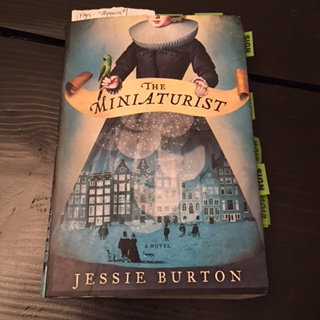
There are books that are masculine and there are books that are feminine, and this is decidedly a feminine book. Set in 1686 Amsterdam, the book tells the tale of eighteen year-old Petronella Oortman’s new life when she arrives at her new merchant husband’s home. The green flags are where I have marked the book’s “mysteries.”
What secrets are kept by her new sister-in-law Marin? Who is the Miniaturist and why does she do what she does (Alas, we are never told the answer to this question, which was a bit unfulfilling, and I have to guess that the Miniaturist is some sort of psychic and uses her powers through her art to try and help or warn her clients). Lastly, why is her new husband, Johannes, so detached from her? This is a book of mysteries, but more importantly than that, this is a book about relationships, love, forgiveness, betrayal, and perseverance. Life marches on, and so does Nella.
The story line between husband and wife was one I certainly was not expecting, and not one I could relate to or want to relate to. Why does Nella care about him after finding out what he did/who he is? I would have left the sucker to rot in prison, and let him march forward to his execution alone. She was not without resources or family, so she could have left, but Nella is not me, so Nella stayed and supported him. Should his punishment have been death by drowning? Certainly not, and the trial proceedings are chilling. Dangerous times.
I did enjoy the character of Nella and the things she persevered through and overcame. The book was a page turner, and kept me reading to finish the 392 page book in about two days. The story did make me think about how awful it would have been to be a woman in that period of time. I am glad I wasn’t, or if I was, that I have not retained hard memories of it now. Even the wealthy women were just property and slave puppets, mostly. Just an awful, awful time.
Interestingly, Petronella Oortman was a real Dutch woman who had a cabinet house. Today, it is on display at The Rijksmuseum in Amsterdam.
Jonathan Howard focuses more on Horst (the vampire brother) in the fourth installment of the series. I thought it was a nice change to have Horst as the main character in this one, and have his personality developed a bit more for us.
A mysterious society (The Ministerium) has raised Horst from the dead. Less Nosferatu / Lord of the Dead, Horst is really more of a Dapper Dan sort of vampire, which makes for some funny reading. Horst soon discovers the true purpose of the society, which is to raise an army of the dead (zombies, vampires, and werewolves, to be even more specific) to take over society. Chapter 8 (“In Which We Encounter Ladies Wearing Trousers”) introduces some female fighter pilots who are fantastically interwoven into the tale. Really enjoyed those audacious trouser-wearing ladies!
One can’t help but read this as a political parody of today’s Globalism / One World movement. It makes you wonder. Would our victory be as clean and clear as Horst and Johannes found their war? Let us hope.













 Jamie Davis Writes