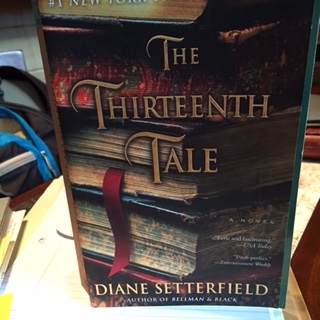
This is my second reading, the first being not long after the book’s release date in 2006. I honestly could not remember a great deal of the plot or why I liked it so much the first time, so approximately ten years later I gave it another look. The second read did not let me down, but I must say that I am noticing that I am getting a little sensitive to violence and any general unpleasantness in my entertainment choices as I age.
The book is not light fare. There are dark family secrets to be unearthed, and you will not be disappointed with the mystery or the way in which it unravels. The 400 pages go by quickly, and I found myself caught up in the story and reading more than usual in long stretches in a desire to know how the story would end.
I almost think of it is a “Secret Garden” for adults, but I don’t know why. Must be the whole English Moors / old mansion thing. I really liked the way Setterfield used the character of Margaret as a biographer for the famous English author Vida Winter, to tell the story. A contemporary gothic mystery novel. I very much liked it still.
Throwback to traveling days for Haunted Asylums, Prisons, and Sanatoriums. A sampling of some of my favorite exterior photos to get into the Halloween spirit!
Yorktown Memorial Hospital – Yorktown, TX
Yorktown Memorial HospitalYorktown Memorial Hospital
I was introduced to the series because of a random walk-in at our local Book Warehouse outlet. The mystery series, starring twelve-year old English heroine Flavia de Luce strikes the right balance between precocious and obnoxious, which is a hard thing to do when writing a child’s character! I particularly enjoyed this seventh book because we got to see Flavia in an entirely new setting (and seemingly alone). Her father and her Aunt Felicity have sent her to Canada to attend Miss Bodycote’s Female Academy, which is the mysterious school that her mother Harriett attended in her own youth.
Things are getting Secret Society good in the land of Flavia de Luce. I will be tuning in for more! It probably isn’t fair to classify this is a guilty pleasure read because that seems to convey that the story/writing lacks substance (which it does not), so maybe “binge-read” is a better term.
Jonathan Howard focuses more on Horst (the vampire brother) in the fourth installment of the series. I thought it was a nice change to have Horst as the main character in this one, and have his personality developed a bit more for us.
A mysterious society (The Ministerium) has raised Horst from the dead. Less Nosferatu / Lord of the Dead, Horst is really more of a Dapper Dan sort of vampire, which makes for some funny reading. Horst soon discovers the true purpose of the society, which is to raise an army of the dead (zombies, vampires, and werewolves, to be even more specific) to take over society. Chapter 8 (“In Which We Encounter Ladies Wearing Trousers”) introduces some female fighter pilots who are fantastically interwoven into the tale. Really enjoyed those audacious trouser-wearing ladies!
One can’t help but read this as a political parody of today’s Globalism / One World movement. It makes you wonder. Would our victory be as clean and clear as Horst and Johannes found their war? Let us hope.
This has got to be one of the best horror reads I have ever read. Admittedly, the Prologue threw me a bit, but by the time I reached Page 57, I was pulling out my post-it pad and writing: “One of the best ghost stories I’ve ever read.” I was talking about the Fenny and Gregory Bate part, which was really a story within the story (one of the Chowder Society member’s stories).
Page 141 – 142: Love the Dr. Rabbitfoot description.
Eva Galli and Alma Mobley? Shapeshifter, but the same timeless creature in both earthly characters? Some creature is playing a game with the members of the chowder society, and I think it sounds more like a shapeshifter vs. a ghost. Fascinating.
I don’t always, but every now and then I will read other reviews after finishing a book to see what other people are taking away from the read. I seemed to see a lot of criticism about this book in the sense that allegedly it is not a good book for women (the whole Eva accidental death thing, mainly). Bear in mind that this was written in 1979 before the liberal police were out in such full force. Also, it really irks me when a random person writes a criticism about a book allegedly because they feel that the author somehow failed this anonymous reader in some way. “I wanted a story about a woman who graduated from college in 1929 and became a teacher, later becoming the Principal of her school.” Um… okay, well go pick up another book, asshole.
I really wish readers would try to give authors a bit more respect in the sense that, here is a human being who had a story in him to tell. He got it out on paper, and told it, and the book is a wonderful thing. Why can’t we just try to enjoy his work (or any work we are reading for that matter) for what it is instead of getting on the whole “I wish he would have done it this way,” or “I would have written blah blah blah snort.”
Well, you didn’t write it. Likely, you haven’t written anything except a grocery list, much less been published. Peter Straub wrote it, and it could not have been any other way. He wrote what he had to say. It isn’t here to please you per your exact spec and wish. Remember this, please. Sit back and let the author tell you his story.
So I guess I will quit reading other people’s book reviews, because it just winds up making me irritated. Everyone is entitled to their opinion, I’m not saying that we all have to like everything, but I prefer it when reviewers are able to say what works for them, what they find inspiring about the writing, or what doesn’t work. Constructive criticism is fine, but for some housewife to get on the internet and pen ignorant reviews of Peter Straub’s work just really kills me. I can’t take it.
Let the Master be, internet reviewers. And by all means, build a fire and make yourself a cup of tea. Pick up this book and read about what the Chowder Society has been getting up to in Milburn.
And… we are back to why I LOVE this series! This time, Johannes does what he does best (in my opinion) — visiting a new world on a quest. This time, Jonathan L. Howard gives a nod to H.P. Lovecraft’s “The Dreamlands.” The Fear Institute scouts Cabal, and they are off to The Dreamlands, to find and destroy the source of all the world’s fear (the Phobic Animus).
I loved that their first stop was across the pond to none other than Arkham, in Massachusetts. Cabal fights monsters, and realizes along the way that he has somehow caught the attention of a God (Nyarlothotep). There is a witch, and a whole gaggle of ghouls, one of which knows him (although Cabal has not yet recognized who the ghoul is – a former human from Cabal’s past).
The Dreamlands and the encounters with the characters (not to mention Nyarlothotep alone) are very trippy, and quite frankly, one of the reasons I read books. It is pure, enjoyable fun. Howard is so witty with his pennings of Cabal’s conversations! I frequently find myself writing “Hilarious!” within the book and marking sections with post-its to read later as examples of how a book should be and why I like it so much.
There is a big twist at the end (beginning in Chapter 14) that I particularly enjoyed, marking the passage as “At which point I begin to say DAMN a lot.” And don’t even get me started on the cat scene in Chapter 12. Yikes! Well done, Mr. Howard. Well done. And thank you for this book.
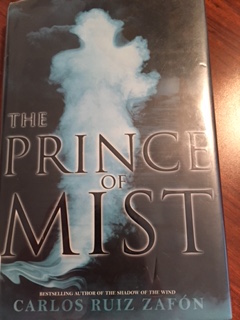
This was Carlos Ruiz Zafon’s very first novel! He wrote it in 1992, but it did not get translated into English until 2010. The Author’s Note in the book explains that his first four novels (preceding the Cemetery of Forgotten Books series, containing: The Shadow of the Wind; The Angel’s Game; and The Prisoner of Heaven) are young adult novels, but that he hoped the books would appeal to all ages. This one will, though I would venture to rate it PG-13 for adult situations.
My expectations were high going in because the series of the Cemetery of Forgotten Books are some of the best three books I have ever read in my life! Mr. Zafon as a first time novelist gave a chilling and sad ghost story. The subject involves: A clock that goes backwards; a mysterious shipwreck; an evil magician; a garden of statues that move; and a family with young children who move into an abandoned beach house – one where the previous owner’s son drowned. The character of Cain has elements that share commonalities with the character of Andreas Corelli in The Angel’s Game, although in this tale Cain is called a “magician” versus outright making him the devil incarnate.
In other news, I got an email blast the other day announcing that the fourth book in the Cemetery of Forgotten Books series will be translated into English in 2018. The book is titled “The Labyrinth of Spirits.” I marked my calendar. That is the first time I have ever had to do that for a release so far in advance! I do not want to miss that book. Meanwhile, I still have the other three young adult novels he authored to read: The Midnight Palace; Marina; and The Watcher in the Shadows.







 Jamie Davis Writes