Search

Jamie Davis Writes

Tag

indexed book journals

Notes From a Reading Journal: When, by Daniel Pink

Notes from a Reading Journal: “When,” by Daniel Pink. Wow, timing really is everything! Thanks to this book, I will aim to NEVER make an important decision in the afternoon again! I will also stay away from doctor’s appointments in the afternoon. 

Some of my best personal gains from this book came from Pink’s tips on how to structure your workday based on your chronotype (I am a lark), and when and how to schedule more frequent restorative vigilance breaks and naps. Not surprising, nature breaks and tech-free breaks replenish us the most!

Pink suggests starting by scheduling three breaks per day, and listing when you will take the breaks; how long they’re going to last; and what you are going to do during the breaks.  

As for how to finish your workday, Pink recommends closing out the last few minutes of your day by writing down what you accomplished since the morning. Then, lay out your plan for the next day. This is PERFECT advice for your Work Journal

Lastly, I loved the study mentioned on Page 324 about time capsules and people going back to their journals and finding them even more meaningful than they expected! I guess there are no ordinary moments. Just moments that we record that make up our lives.

Quotes I Collected in my Reading Journal:

·      Page 54: “Whatever you do, do not let mundane tasks creep into your peak period.” 

·      Page 80: “Regardless of our chronotype, the afternoon can impair our professional and ethical judgment… Inserting regular mandatory vigilance breaks into tasks helps us regain the focus needed to proceed with challenging work that must be done in the afternoon.” 

·      Page 88: “High performers work for fifty-two minutes and then break for seventeen minutes.”

·     “Pause Like a Pro: Most expert musicians and athletes begin practicing in earnest around nine o’clock in the morning, hit their peak during the late morning, break in the afternoon, and then practice for a few more hours in the evening.” 

Deeper still, is the note about Warren Buffet’s conversation with his private pilot on achieving things in life. Buffet told his pilot to start by writing down his top twenty-five goals for the rest of his life, and then to pick his top five goals from the larger list. Those five goals would be the focus of his energy and priorities, and he would have to let the other twenty go until he had first achieved his top five. 

The Buffet exercise has my head spinning right now. I have my top 5 picked out, but I consider them to be ongoing projects. Personal things that require maintenance and work constantly. Relationships, health, operating businesses. The big parts of my life. Sure, I can rattle off 20 other “that would be cool to do” types of things, but as far as goals, I think staying healthy and happy and maintaining relationships will always be top 3. I’m not sure if I don’t care about enough things, or if my reaction to this exercise proves that I already had my focus on the right things. 

I’m thinking the Top 25 exercise is for people who are lost and haven’t done a lot in their lives, maybe, and they approach middle age with panic because they just haven’t done anything. My mind continues to reel, but I am not lost. I am not operating in the dark about defining goals. Maybe it is time to flex and dream a bigger dream. 

Notes From a Reading Journal: As Bright as Heaven, by Susan Meissner

Notes from a Reading Journal: “As Bright as Heaven,” by Susan Meissner.

This is a story of the Bright family, but mostly involves mother Pauline, and her three daughters as they transition from rural Pennsylvania to Philadelphia to begin anew in their father’s uncle’s mortuary business. The setting for Part 1 is 1918 amongst the Spanish flu outbreak. Part 2 takes part in 1925. 

This book made me cry so many times, and that is unusual for me! The story involves Death, yes, but there is not just darkness in Death to be discussed. The book also covers hope, redemption, and building a life in the aftermath. 

This was my selection for January’s Book of the Month Club. I always enjoy exposure to new releases through BOTM club because I come to rely on them for true literary picks. Meissner is a writer’s writer, and her language is beautiful to read.   

Relationship/how you view the world questions to discuss with book club:

  1. How do you see the Grandmother’s choice in refusing Pauline and the girls to return home during the flu outbreak in Philadelphia?
  2. Would you have made the same choice as Evelyn did with Conrad and Sybil?
  3. If you were Evelyn, would you have made the disclosure about Alex to Ursula, or would you have taken that secret to your grave?
  4. If you were Maggie, would you have proceeded forward with Palmer, or waited for Jamie?
  5. Do you hold the same belief as Papa as far as one love of your life? Why/why not? 

Quotes I Collected in my Reading Journal:

·      Page 97: “Even now I sense the enemy is not who we think it is. My companion hovers kindly in the hellish corners in the funeral home. Like a valet, like a dance partner.”

·      Page 111: “I would leave off my sliver of a worry that she had begun to sense my companion’s shadow in the corners of our home. I don’t think Death has been watching her as it watches me, but who can say what that specter is truly up to?”

·      Page 301: “Might you marry again, Papa? Your Mama is the only woman I could ever love, the only woman I was ever meant to love.”

Pressing Play: A Look Inside My Play Journal (Arizona)

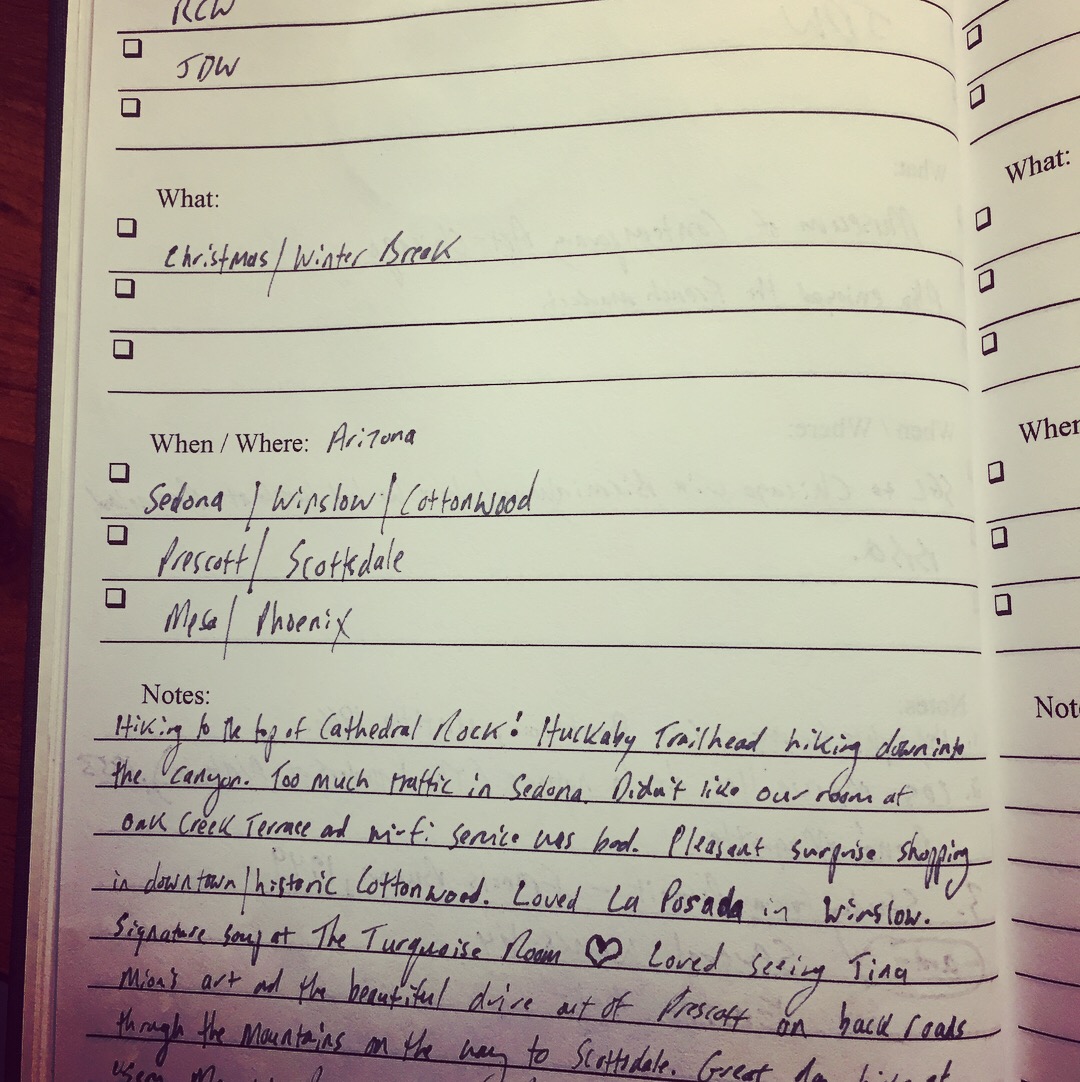
The Play Journal revisits Arizona. Some places I’ve seen.  

Notes from the road - Arizona
Notes from the road – Arizona

Yes! We made it to the top of Cathedral Rock in Sedona! It doesn’t look like much from the photo, but it is. There is plenty of freestyle rock climbing involved to get to the top. Very nice, and at 8:30 a.m., there were only 6 or so more people at the top when we arrived. We were even able to find parking at the trailhead. 

Cathedral Rock - Sedona, AZ
Cathedral Rock – Sedona, AZ

After hiking to the top of that rock, we went to look at a hole in the ground (read: Meteor Crater) and stand on a corner (in Winslow, Arizona). A local drove past in an old pick-up truck and screamed at the tourists: “Eagles suck!” It was so awesome. They pipe out very loud music on this corner, and I don’t blame the guy at all. 

standingonthecorner.JPG

The real gem in Winslow is the La Posada Hotel with the Turquoise Room’s signature soup, and co-owner Tina Mion’s art galleries. La Posada is a former Harvey House Hotel designed by Mary Coulter and opened in 1930. For a second I thought I had stepped into the Hotel California.

Amtrak’s Southwest Chief still stops at the hotel. Is it haunted? I don’t know, but I could certainly sense the past there, and it was an electrical past reminiscent of the feelings I got when I would visit the Jerome Grand Hotel in Jerome, Arizona. If history/place memory is a synonym for a haunting, then yes, to me it is haunting. In the most peaceful, comforting way imaginable. There was a Twilight Zone type of feeling (Next stop, Willoughby?). 

I wish I could have spent some more time here. Certainly I would have traded my nights in Sedona for nights here. Old America is the feel. A taste of a simpler time, maybe. Maybe I long for something that never was, but I had the sense that I could find something here that I needed. A moment in time that was essentially timeless. I could have been in 1930, 1954, or 2017. But I was there. I lived there for a time. 

Tina’s description of Mionland brought tears to my eyes. It involves the death of her grandmother. I knew it was about death the second I saw it, because the senior lady is standing up beside her wheelchair with her cane propped against the back, clutching her purse. She got called up. She’s waiting to transfer stations. I instantly “got” Tina’s work, and it was a powerful experience wondering through the public areas of La Posada, studying her paintings, and then reading her placards. What an unexpected treat!   

Mionland - 2010
Mionland – 2010
A New Year's Party in Purgatory For Suicides in Which Liberace Makes a Guest Appearance Down from Heaven Just for The Hell of It. 
A New Year’s Party in Purgatory For Suicides in Which Liberace Makes a Guest Appearance Down from Heaven Just for The Hell of It. 

The guest list at the New Year’s Party includes: Sid Vicious; Jimi Hendrix; Sylvia Plath; Judy Garland; Ernest Hemingway; Marilyn Monroe; and Kurt Cobain, just to name a few. The most fascinating mystery to me is who is the young boy at the back of the photo – standing in the doorway?

Favorite hike in Mesa: Pass Mountain at Usery Mountain Park.

Most beautiful drive: Prescott National Forest to Scottsdale, passing Wickenburg. 

Sedona Love = Tableside guacamole at the Mesa Grill at the airport. Morning hikes. Red rocks.  

Sedona Hate = poor wi-fi at Oak Creek Terrace and strange spiral stairs in room, with the shower located downstairs, and the half-bath located upstairs in the master suite. Never again! Who builds a layout like that?! Word to your mother – do not book Room 16. Terrible holiday traffic trying to get through town! So bad, we went to Scottsdale one day early to escape the traffic! 

Travel. Write. Index. Buy Stealth Journals. Repeat — Jamie Whitmer

Notes From a Reading Journal: Uncommon Type, Some Stories, by Tom Hanks

Notes from a Reading Journal:Uncommon Type, Some Stories,” by Tom Hanks. Yes, THAT Tom Hanks! This was a November Book of the Month Club selection.

The man is obsessed with typewriters, and great fun can be had by identifying how the typewriter is mentioned in each short story. For this reader, “These are the Meditations of My Heart” was worth the price of admission. My other two top picks are: “The Past is Important to Us,” and “Stay with Us.” In “Past” the reader is introduced to a man who has everything, but still tries to cheat time. He had everything, but he still wasn’t satisfied. In “Stay” the reader is led on a nostalgic road trip that is reminiscent of Route 66. 

Set out to find America…

I dare you to read these stories, and in particular, “Meditations” and resist the urge to go buy a typewriter! I found myself pricing options last night after I finished reading this book! After reading “A Junket in the City of Light,” you just have to wonder if this is based on a true Hollywood story.  

Quotes I Collected in my Reading Journal:

  • Page 6: “I am one of those lazy-butt loners who can poke my way through a day and never feel a second has been wasted. In fact, as soon as I sold my mom’s house and parked the money in investments, I walked away from my fake businesses and settled into the Best Life Imaginable. Give me a few loads of laundry to do and a hockey game on the NHL channel and I’m good for an entire afternoon.”
  • Page 79: “The hotel had been recently renovated in Hipster-Millenial.”
  • Page 99: “And the Martians, as they called themselves, had all gotten older, mellower. Except for a couple of asshole lawyers.”
  • Page 180: “Think about what? Sue studied her new professional call sheet. She liked herself more because of what Bobby had typed.” — Ah yes, the magic of words! 
  • Page 234: “I’m not one who types between sips from a tumbler of booze and drags from a pack of smokes. I just want to set down what few truths I’ve come to know.”

Happy reading! Really, is there anything that Tom Hanks doesn’t do well? — Jamie Whitmer

Notes From a Reading Journal: The Rules of Magic, by Alice Hoffman

Notes from a Reading Journal: “The Rules of Magic,” by Alice Hoffman.

What a heartbreakingly enchanting novel! I am so glad that Book of the Month Club made this my November selection. Now I have marked “Practical Magic” on my to be read list!

I loved the 1960s Manhattan and Massachusetts setting, and the relationships between siblings Vincent; Jet; and Franny and their respective loves. The fact that there is witchery afoot was sort of a “fun” element for me. In my opinion, the real star of the show is the heartbreak and joy of the stories of the lives of the characters.

This is a story of how each life ends for a time, but begins again. Will the Owens siblings beat their family’s curse?  

Two big questions that I noted while reading that I was happy were resolved were:  What was Vincent’s premonition? How was it right / how was it wrong? What did Isabella whisper to Franny?

I had to note the roles that journaling played in the story as well! Maria Owens, the  ancestor, had a journal that was kept in the rare book room in the library. Later, Franny would leave journals out for the teenage girls to pick up and take home (“Clearly convinced that words could save them – p. 314.”) I loved that!

Quotes I Collected in my Reading Journal:

·      Page 161: “What’s done cannot be undone.”

·      Page 254: “Nature could be shifted, but not controlled.”

·      Page 257: “Things ended, and then they began again.”

·      Page 57: “Writing itself was a magical act in which imagination altered reality and gave form to power. To this end, the book was the most powerful element of all.”

·      Page 346: “The truth was, they had managed to get what they wanted. It just wasn’t lasting long enough, not that it ever could.”

·      Page 331: “In truth it is easier to let your old life disappear in order to start anew.”

Love more. Not less. — Jamie Whitmer

Pages From a Secret Diary Journal: Tim Ferriss’s “Replacement Beliefs”

Confessions from the pages of a secret diary journal are pictured above.  

Looking back to last December, when I was reading Tim Ferriss’s “Tools of Titans,” and working the exercise that involved listing your current handicapping beliefs and then replacing them with 2-3 new beliefs. Such a powerful journaling exercise! It is oh so raw to share the handicapping beliefs, but I will. They were: 1. Afraid of cutting a certain project out of my life for fear of how I would replace the income. 2. I don’t know how to run a “real” business. 3. I’m not creative enough. 4. I’m not good enough at networking to be successful. 5. People are only going to want to buy things at such a low cost that it won’t even make sense to be in business. The replacement beliefs are pictured.

Such a raw, powerful exercise from Mr. Ferriss! 

This secret diary journal can be purchased here

Notes From a Reading Journal: Little Fires Everywhere, by Celeste Ng 

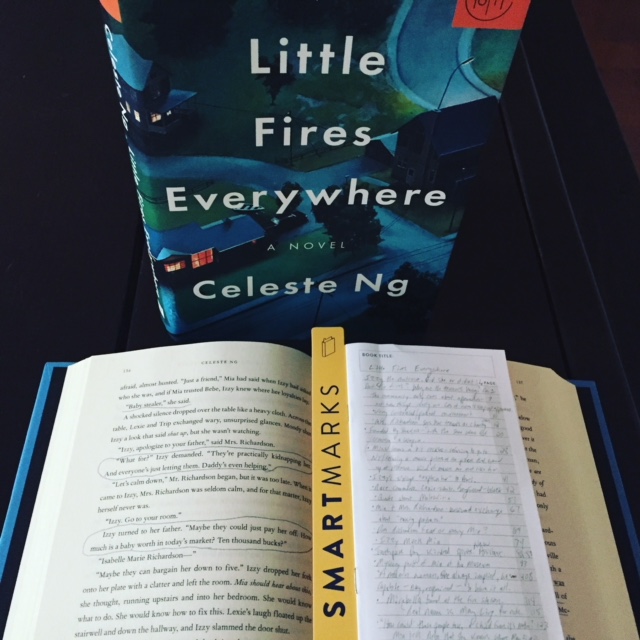
Notes from Smartmarks by BestSelf Co, while traveling without my reading journal. These bookmarks with notes were the perfect travel solution for me! At home, I keep a reading journal for my notes, but I was able to tear my notes out when I got home and filed them within my reading journal. The Smartmarks were very convenient! 

This selection was an extra purchase I made through Book of the Month Club after hearing so much buzz about the book. I found “Little Fires Everywhere” to be an absorbing book, guaranteed to make you think and spark debate among book club members everywhere. 

At first, I thought the book was going to be focused more on Izzy and her alleged “craziness,” as her siblings refer to her issues, but it was more of a character study of Izzy’s entire family (the Richardsons) and their new tenants, artist mother Mia and her daughter, Pearl. By the way, Izzy is not “crazy,” she just doesn’t fit into the cookie-cutter mold her family wishes to mold her into.

While there were plenty of witty and even positive exchanges in the story, make no mistake about it, this is no fairy tale happy ending of a story. Ideas to spark discussion come from such themes as: teenage pregnancy; adoption; what lies beneath the “perfect” neighborhood; what makes someone a mother; and what is heartbreak. What are the things that we carry with us? 

What are the sacrifices we make in the pursuit of a better life? Were they worth it?

The story takes place in Shaker Heights, a planned community that has lots of rules, and is the embodiment of a neighborhood that is really only concerned with the surface being perfect, and damn what lies beneath! 

In my opinion, the most evil character is do-gooder suburban mother Mrs. Richardson. She ruins lives by her interference. She never does a good deed without calculating it for a return favor later, and if she does something she deems “good” for another person, she expects the recipient to kowtow to her. And oh, how judgmental she is. Mrs. Richardson actually may take the nomination for most-hated literary character this year. 

Mia, the artistic mother, is highly gifted, but will not “sell out” when it comes to her art. Thus, she provides a poverty-stricken, nomadic lifestyle for her daughter, Pearl. Yet, she somehow always manages to supplement her artist’s income with menial jobs, and while they are not rich in material goods, they don’t seem to go without the necessities. This is a huge debate for readers to discuss. What is the parental obligation to provide for a child? If you have the ability to generate a lot of income, what is your obligation to make money if you are able? To what extent does security and stability come in to play over adventure and art when raising a child on your own? We know that Mia had the talent and the connections in Manhattan to make a great deal of money as an artist, but she did not want to sell out. (Arguably, she may have been worried about becoming too high-profile because then she may have caught the attention of the Ryans, which if you have read the book, you know she had to stay hidden).   

Another big issue for debate is what readers think of Bebe giving up May Ling and then the custody battle between her and the adoptive parents, Linda and Mark McCullough. Do you think the judge’s ruling was fair? What do you think about Bebe’s actions in the end of the book? Are there circumstances so severe that people no longer deserve a second chance?

The way Ng interweaves the story of Mia and Bebe is masterful. I was engaged, and wanted to keep reading to find out Mia’s secrets. 

Other relationships and questions to discuss: the relationship between Mia and her parents; what you think of the relationship between Mia and the Ryans; does Lexie regret her big decision; and who does Pearl’s heart break for – the loss of the relationship with Trip or with Moody? What do you think happens to Izzy in the end? 

Quotes I Collected for my Reading Journal:

·      Page 245: “You’ll always be sad about this, Mia said softly. But it doesn’t mean you made the wrong choice. It’s just something that you have to carry.” 

·      Page 250: “The question is whether things are still the same. Whether she should get another chance… Most of the time, everyone deserves more than one chance. We all do things we regret now and then. You just have to carry them with you.” 

·      Page 295: “Sometimes, just when you think everything’s gone, you find a way… Like a prairie fire. I saw one, years ago, when we were in Nebraska. It seems like the end of the world. The earth is all scorched and black, and everything green is gone. But after the burning the soil is richer, and new things can grow… People are like that, too, you know. They start over. They find a way.”

Fun and Games at the Museum of Contemporary Art: A Look Inside My Play Journal

Making notes inside my Play Journal of some of the exhibits at the Museum of Contemporary Art in Chicago. I can always spot Francis Bacon a mile away, because some guy is always screaming his head off! 

Study for a Portrait, 1949
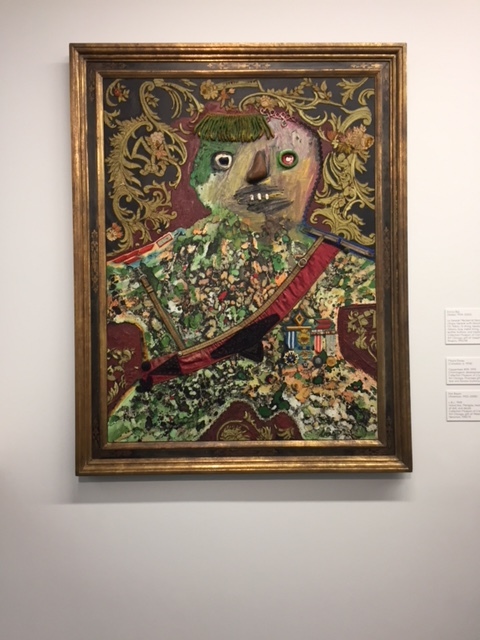
Encounter, 1966. Enrico Baj. This was my first time seeing works by Enrico Baj, and they were very interesting to study. I like the way he used actual medals for this collage of two generals.  
IMG_5509.JPG
Untitled, 1966. Lee Bontecou. I first saw works by Bontecou at this very museum in May of 2013. The steel; canvas; and lighting make a very powerful statement!
Les merveilles de la nature, Rene Magritte, 1953. I always love trying to interpret Magritte's work! Fish-human hybrids made of stone. What is he trying to tell us?!
Les merveilles de la nature, Rene Magritte, 1953. I always love trying to interpret Magritte’s work! Fish-human hybrids made of stone. What is he trying to tell us?!

Notes From a Reading Journal: Before the Devil Breaks You, by Libba Bray 

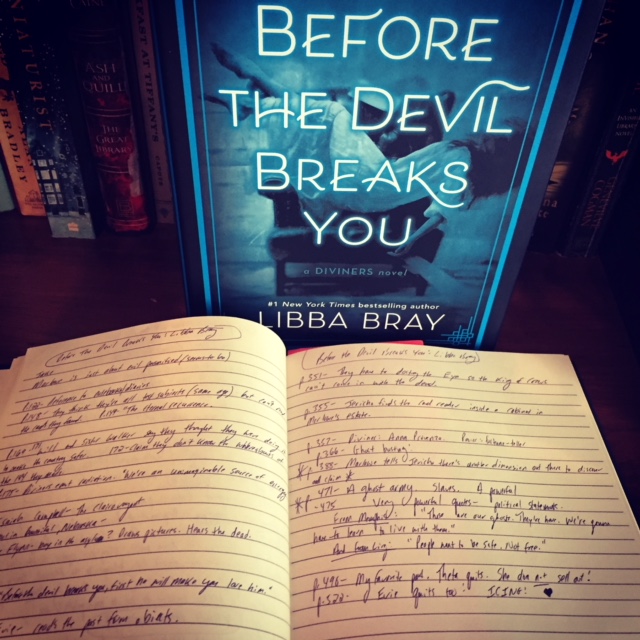
Notes from a Reading Journal

Before the Devil Breaks You” is Book 3 in the 4-part Diviners series by Libba Bray.

There is a lot going on in Book 3! I adore this 1920s paranormal series! Libba Bray acknowledges that at the time she was writing this book, there was a lot going on in America politically, and I think she strikes the perfect balance of writing for entertainment without preaching politically. That’s a hard thing to do, by the way. Having just finished Stephen and Owen King’s “Sleeping Beauties,” even recognized masters get this wrong. There is entertainment, and then there are political pieces masked as entertainment. Ahem. But I digress…  

First, the “fun” elements in the plot of “Before the Devil Breaks You.” The Diviners visit an asylum to hunt ghosts, and there is ghostly activity around Manhattan that might remind the reader of the movie “Ghost-Busters”. I also enjoyed learning the lingo from that time period. The characters say such phrases as: 

         “You jake?”

         “Strictly top-drawer”

         “Baby Vamp”

         “And how!”

         “On the level”

         “Let’s ankle”  

Now on the darker fare. The King of Crows is back with an army of the dead. I’m still trying to figure out what the “Eye” is, but it sounds to be some sort of portal between Earth and another dimension (seemingly the land of the dead or wherever The King of Crows comes from. Hell? Because without question, The King of Crows is a demon). I think the “Eye” is going to be the focus of the last book as far as the Diviners are supposed to find it and destroy it, thus finally closing the entry door of Earth to The King of Crows. I got the impression that it has to do with Marlowe and his quest to discover and conquer another dimension. Marlowe is just about evil personified on Earth!

In the book, we delve deeper into Project Buffalo’s roots inside the Department of Paranormal, a former government agency. This agency’s purpose was to engineer Diviners in the womb, in an attempt to breed a race of super-powered Americans. Just as in the real 1920s Eugenics Record Office at Cold Spring Harbor Laboratory on Long Island, which Bray writes in her author’s note, “supported by Harrimans, Carnegies, and Rockefellers.” This story line is absolutely terrifying and evil, and even more so because it is based on reality!

We find out that Evie; Theta; Henry; Sam; Ling; Memphis; and Isaiah were all manufactured to have super powers that were derived by administering Marlowe’s serum to their mothers. The specific power that would develop as a result of administering the serum seems to be something that the agency could not control. 

The portrayal of the Manhattan State Hospital for the Insane was inspired by a fictional amalgam of real New York Kirkbride asylums and their cemeteries, such as Ward’s Island; Roosevelt Island; and Hart’s Island. I liked the mention of Nellie Bly’s 1887 “Ten Days in a Mad-House” to demonstrate how investigative journalism led to sweeping reform in the state’s asylums, and led to much better care of the mental ill by the 1920s. However, there were still terrifying things going on, and one of the scariest things was sterilization under the Supreme Court’s 1927 ruling in Buck v. Bell. 

Quotes I Collected in my Reading Journal:

·      Page 12: “When you talk about seeing ghosts, most people assume you’re either crazy or drunk or both.”

·      About writing, from Ling’s perspective. Page 51: “Ling cracked open the notebook, inhaling the scent of good leather and of the possibilities lurking in all those blank pages.”   

·      P. 185: “Before the Devil breaks you, first he will make you love him.”

·      By Memphis, P. 475: “These are our ghosts. They’re here. We’re gonna have to learn to live with them.” And from Ling, “People want to be safe. Not free.”

Other revelations? Two main characters are murdered. We finally find out who Blind Bill Johnson is, and that’s a great story line (There once was a Diviner who could pull life from things…)! Evie and Theta both quit their show-business jobs rather than be forced to be controlled by their bosses, which were very inspiring actions. Shame about Jericho and Evie, though. I’ll leave it at that. I wish that part of the story didn’t have to happen.  — Jamie Whitmer

Create a free website or blog at WordPress.com.

Up ↑